Introduction
For architects, developers, real-estate companies, and construction teams, one of the hardest things to sell is something that does not exist yet.
A building may still be on a drawing board. A residential tower may be months away from construction. A commercial development may exist only as floor plans, CAD files, or 3D models. Yet clients and investors are expected to understand what the finished project will look and feel like.Traditional architectural visualization solves part of this problem, but it can also be slow, expensive, and difficult to update. Every design change may require new renders, revised scenes, and additional production work.
What Is AI Pre-Visualization?
For example, imagine a developer planning a waterfront residential tower.
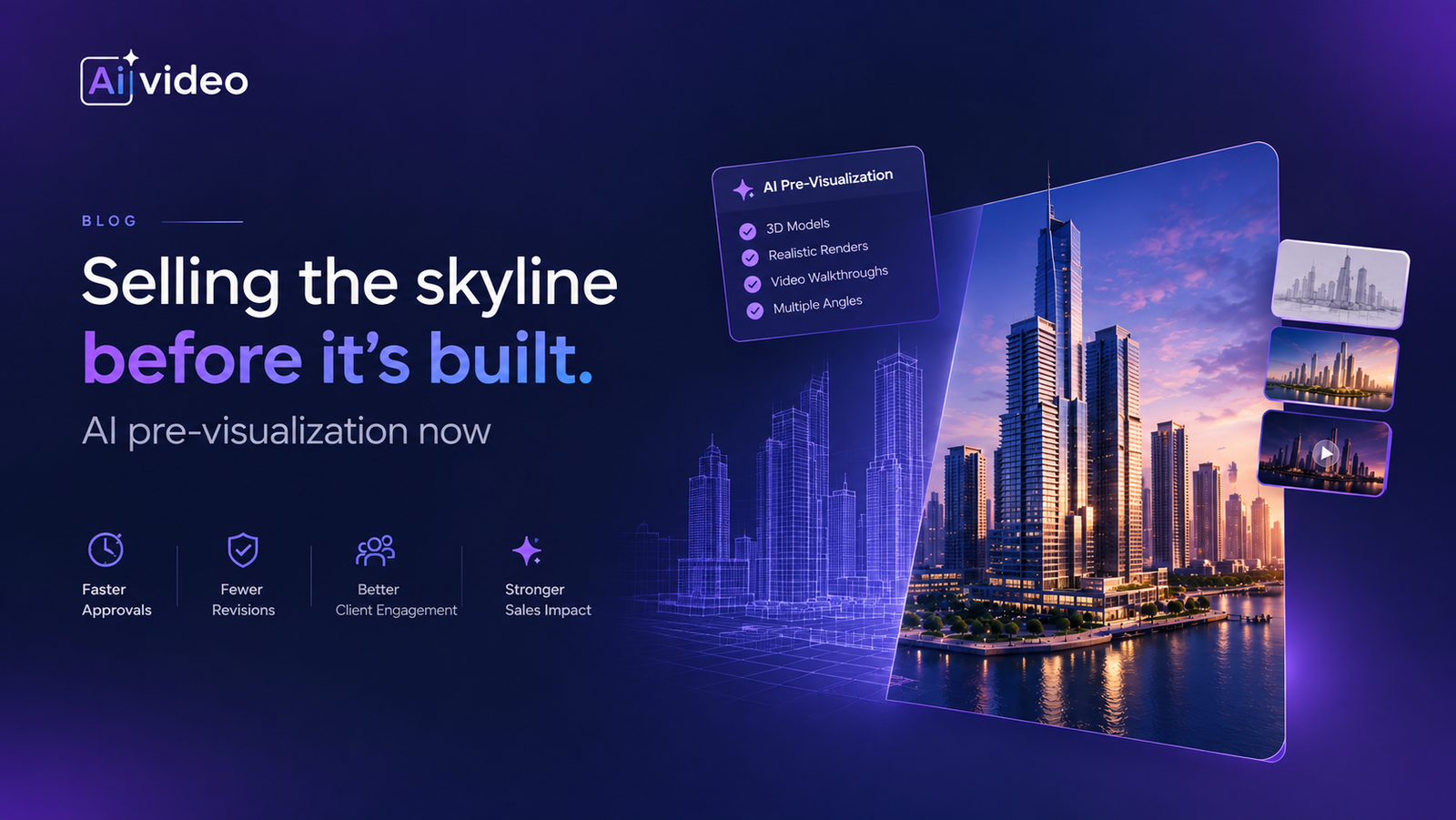
Instead of showing investors only technical drawings, the team could present a visual sequence showing:
- The building from the street
- The view from a nearby park
- The lobby and common areas
- The surrounding skyline
- Day and night environments
- Different façade concepts
- A potential resident experience
The goal is not simply to make something look attractive. It is to make an abstract idea easier to understand.
From Blueprint to Experience
A static floor plan can become a visual walkthrough. A basic massing model can become a realistic exterior concept. A simple site plan can be transformed into an environment showing landscaping, lighting, roads, and surrounding buildings.This gives stakeholders something much closer to an experience rather than just technical information.
Faster Design Exploration
One of the biggest advantages of AI-assisted visualization is speed.
Architecture and real-estate projects rarely remain unchanged. A client may request a different façade. A developer may want another landscaping concept. An investor may ask to see the project at night. A marketing team may need a completely different perspective.With a traditional workflow, each change can involve additional modelling, rendering, and post-production.
AI can help teams explore these alternatives much faster.Instead of asking, “Can we afford to visualize another version?”, teams can begin asking, “Which version should we test next?”That shift can encourage experimentation before expensive physical decisions are made.
A Better Pre-Visualization Workflow
A practical workflow can look like this:
Concept → Reference Assets → AI Visualization → Review → Iteration → Final Presentation
The team starts with existing project information such as sketches, CAD data, 3D models, site photographs, materials, or mood boards.AI-assisted tools can then generate different visual directions. The professional team reviews those outputs, corrects inaccuracies, and develops the strongest concepts further.This creates a faster feedback loop without removing human judgment.
The Future of Selling Unbuilt Projects
A project no longer needs to reach the final rendering stage before teams can begin communicating its potential.
Developers can explore ideas earlier. Architects can present more options. Marketing teams can create campaigns sooner. Investors can understand concepts more clearly. Buyers can experience a project before construction is finished.
Conclusion
AI pre-visualization gives architecture, construction, and real-estate teams a faster way to turn early concepts into compelling visual stories. It can support design exploration, stakeholder communication, presentations, and even marketing campaigns long before the first brick is placed.But the technology works best when it supports—not replaces—professional expertise.
The future is not about creating the most impressive AI-generated building image.It is about giving people the ability to see the possibility before the project becomes reality.