
Introduction
E-commerce brands are constantly competing for attention. A customer can scroll past dozens of products in a few seconds, which makes creative content one of the most important parts of an online advertising strategy. The problem is that producing enough high-quality video ads to keep up with different audiences, platforms, offers, and campaigns can become expensive and time-consuming.
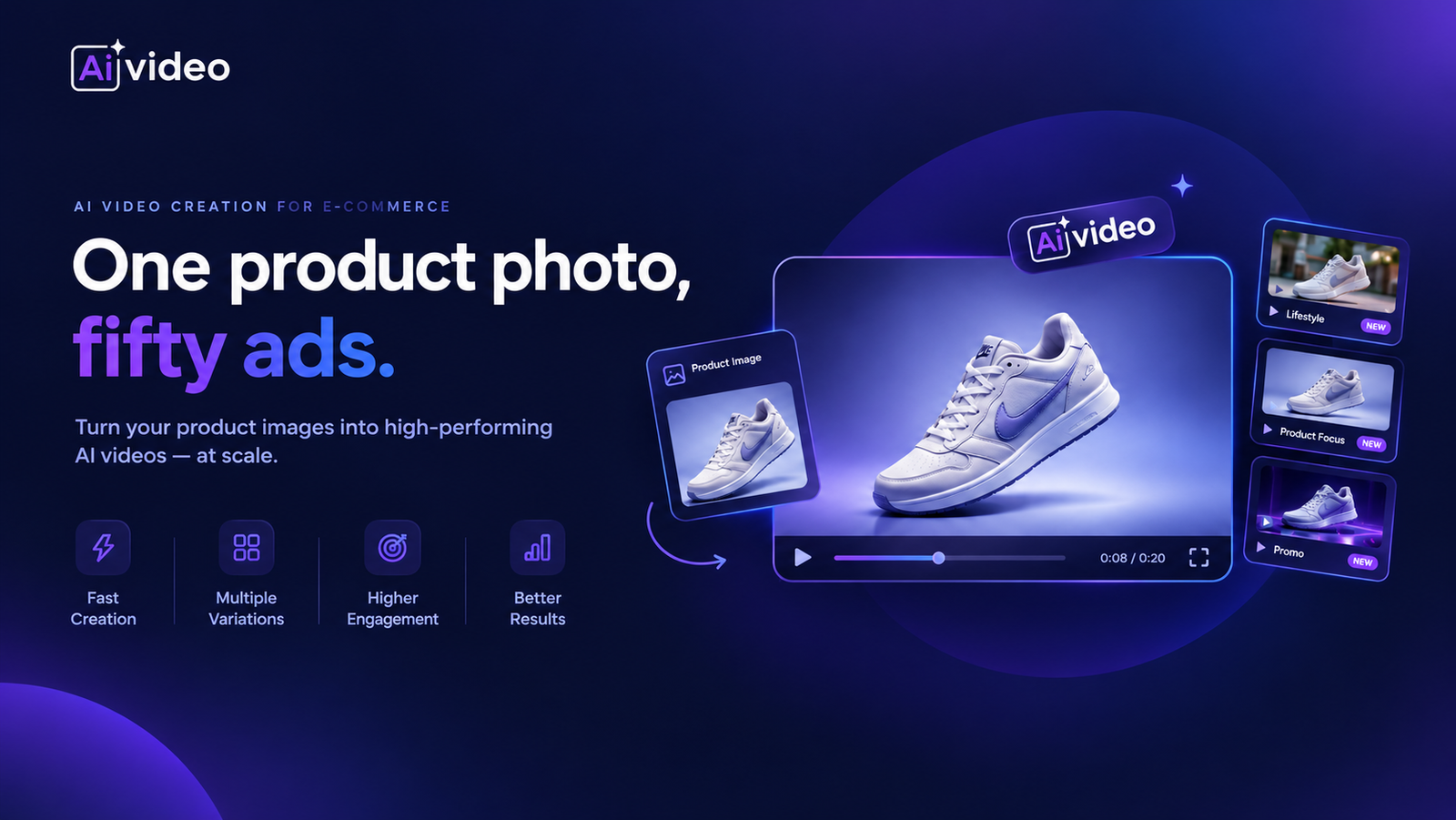
Traditionally, creating one product video could require a script, location, camera setup, models, lighting, editing, voice-over, and several rounds of revisions. Now, AI video tools are changing that process. Instead of creating every advertisement from scratch, brands can start with something as simple as one product photo and turn it into dozens of different video creatives.
This does not mean AI can replace creative strategy. The real advantage comes from using AI to increase the speed and volume of production while keeping the brand message consistent.
From One Product Photo to Multiple Ad Creatives
Instead of arranging a complete video shoot, the marketing team can begin with a high-quality product image. AI-powered video generation can then help transform that single asset into different creative concepts.
The same product could appear in:
- A clean product showcase
- A problem-solution advertisement
- A lifestyle-style video
- A product benefits video
- A promotional sale video
- A customer testimonial-style creative
- A short social media ad
- A comparison-focused video
- A seasonal campaign
- A retargeting advertisement
The product remains the same, but the story, hook, visuals, pacing, and messaging change.
That distinction matters. Scaling advertisements is not about making the same video fifty times. It is about creating fifty opportunities to discover which creative connects with a particular audience.
Why Creative Volume Matters in E-commerce
One of the biggest challenges in paid advertising is creative fatigue.
An advertisement that performs well today may gradually lose effectiveness as the same audience sees it repeatedly. When brands depend on a small number of creatives, performance can decline without giving the marketing team enough alternatives to test.
AI video production can reduce this bottleneck.
Instead of waiting weeks for a new production cycle, marketers can create new variations much faster. Different hooks, formats, product angles, calls-to-action, and visual styles can be tested continuously.
For example, a single product could have three different opening hooks:
“Still struggling with dry skin?”
“Meet your new everyday moisturizer.”
“Here’s why thousands of shoppers are switching.”
The rest of the advertisement can remain relatively similar while the opening changes. This allows marketers to test which message attracts attention instead of relying entirely on assumptions.
Building a Scalable AI Video Workflow
A practical e-commerce workflow can start with a small collection of existing assets:
- Product photos – Use high-quality images as the foundation.
- Brand guidelines – Define colors, fonts, tone, and visual identity.
- Customer insights – Identify common problems, objections, and buying motivations.
- Creative hooks – Develop multiple ways to capture attention.
- AI video generation – Turn concepts into different video variations.
- Human review – Check product accuracy, messaging, visuals, and brand consistency.
- Platform adaptation – Create formats suitable for different placements.
- Performance testing – Measure metrics such as watch time, CTR, conversions, and ROAS.
- Iteration – Produce more variations based on actual performance data.
This turns AI from a novelty into a production system.
The Future of E-commerce Creative Production
That means understanding customers, developing stronger creative concepts, testing systematically, maintaining product accuracy, and learning from performance data.A product photo is no longer necessarily the final asset. It can become the starting point for an entire library of advertisements.
Traditional Product Video: Where It Helps and Where It Adds Work
Filmed product video is useful when customers need to see the real item being handled, used or demonstrated. It can show details, movement and genuine interaction that should not be invented. Explore our filmed product video production service when capturing the actual product is central to the brief.
The practical challenge is coordinating the product, people, lighting, location and shot list before recording. A new scene or demonstration may require another shoot, and producing many distinct concepts can add planning and review work. Existing footage can still be edited into new hooks, lengths and formats, so filming does not mean every variation needs to be shot again.
AI Product Video: An Alternative for Asset-Based Variations
If the brief can be supported by approved product photos, information and brand assets, AI-assisted production offers another way to explore visual concepts and campaign variations. For suitable projects, it can reduce reliance on additional filming while human creative direction, editing and review shape the finished video. Explore our AI product video production service for an asset-based approach.
AI is not automatically cheaper, faster or more accurate for every brief. Generated clips can alter labels, packaging, proportions or product behaviour, and unsuitable outputs need correction or rejection. Do not use generated demonstrations as evidence of a feature the real product does not have. Compare the full scope, available assets, review requirements and deliverables before choosing an approach.
Choose the Method Around the Product and Campaign
Use filming when genuine use and exact physical detail need to be captured. Consider AI-assisted visuals when approved assets can support the concept and appropriate accuracy checks are possible. A project can also combine filmed footage, animation and AI-assisted variations. Production method, filming availability and deliverables are confirmed in the project quote; neither approach guarantees campaign results.
Conclusion
E-commerce advertising is moving from a production-heavy model toward a more flexible and iterative creative process. With AI-assisted video generation, one product photo can become dozens of advertising concepts designed for different audiences, platforms, and stages of the customer journey. Explore our AI product video production service.
But scale alone is not the goal.The goal is to create more relevant creative, test more ideas, learn faster, and reduce the time between insight and execution.One product photo can potentially become fifty ads. The real question is not how many videos AI can generate.It is how many meaningful ideas your brand can testand how quickly you can turn the winners into your next campaign.